How Often to Trim
VCA says most dogs need their nails trimmed about once a month; dogs that walk on pavement or concrete may go longer, and less active dogs may need a trim every three weeks. Its test is simple: trim when the nails touch the ground or you hear them click on a hard floor.[1] The AKC says every three to four weeks, depending on activity level and how quickly the nails grow, and adds that some dogs wear their nails down and need fewer clips.[2] Long nails are more than a noise problem: the AKC says they can splay the foot and reduce traction, and over a long period can deform the feet and injure the tendons.[2]
What You Need
| Tool | What it is | Source |
|---|---|---|
| Guillotine-style clippers | The nail is fed through a hole and a blade rises to cut it | VCA |
| Scissors-style clippers | Shaped like scissors, with two moving blades | VCA |
| Dog nail grinder | An electric tool that files the nail down | VCA, AKC |
| Styptic powder | For a nail cut too short; VCA also names flour or cornstarch | VCA, AKC |
VCA says a grinder leaves the end of the nail smooth, carries less risk of damaging the quick, and is better tolerated by some dogs that dislike clipping. It also warns that the spinning file can tangle in long hair, that a slipping file can cause a severe skin burn, and that the dust can irritate people and presumably dogs, so it suggests using one outdoors.[1] The AKC lists scissors, guillotine clippers and dog-specific grinders as options.[2] Pick the one your dog accepts and you can control.
Step by Step
- Get your dog used to the tool first. The AKC lays out a seven-day plan with treats and praise at each step: day 1, let the dog sniff the clipper or grinder; day 2, touch it lightly to each paw; day 3, squeeze the clipper so the dog hears it, or run the grinder so the dog feels the vibration, without trimming; day 4, touch the tool to the feet again; day 5, trim only the very tiniest tip from one front-paw nail; day 6, trim just the tips of two nails; from day 7, add nails each day until all are done and the dog does not mind.[2] VCA says to see a vet or groomer if the nails urgently need trimming before that training is finished, and that a vet can provide sedation if needed.[1]
- Take the paw in your hand and look at the nails.[1] Support the toe firmly but gently.[2]
- Clip a little at a time. VCA says to remove 1 to 2 mm with each clip and to make the final cut about 2 to 3 mm from the quick, at or near the point where the nail begins to curve.[1] The AKC says to clip only the tip, straight across.[2]
- Do not skip the dewclaws. VCA says they do not touch the ground and can overgrow or curve into the paw pad.[1] The AKC includes them in the trim.[2]
- Stop and reward. A short, calm session beats a long, stressful one.
Trimming Black Nails
On a dark nail you cannot see the quick. VCA says to trim just the very tip off the nail.[1] The AKC says to watch for a chalky white ring.[2] Keeping each clip to 1 to 2 mm, as VCA advises for any nail, keeps every cut small.[1] If you are unsure, take less; you can always trim again later.
If You Cut the Quick
It happens to everyone. VCA says to apply styptic powder to the end of the nail, or flour or cornstarch if you have no powder.[1] The AKC says to apply styptic powder immediately and to contact a vet if the bleeding does not stop.[2] Keep the powder next to you before you start, not in a cupboard.
What to Buy
The criteria are simple: a clipper or grinder you can control, and styptic powder within reach. These three meet them.
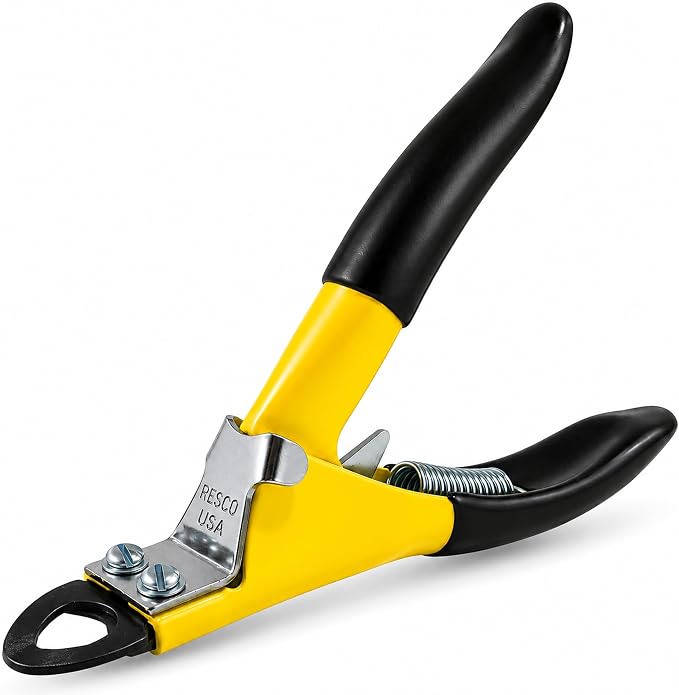
Resco Guillotine Style Dog Nail Clippers for Large Dogs and Cats
A classic guillotine clipper, one of the two clipper styles VCA describes, with replaceable blades. This is the large-dog size, per the listing.
Pros
- Replaceable blades, per the listing
- Larger opening for thick nails (large-dog size)
- Made in the USA since 1937, per the listing
Cons
- Large size, so check the size for a small dog or a cat
- Needs a steady hand; take off 1 to 2 mm at a time as VCA advises

Casfuy Dog Nail Grinder, 2-Speed Electric Pet Nail Trimmer
A two-speed electric grinder, the option the AKC lists next to clippers; the listing describes three grinding ports for small, medium and large nails.
Pros
- Two speeds, so you can start gently on a puppy or delicate nails, per the listing
- Three grinding ports for different nail sizes, per the listing
Cons
- We have not used it, so we can only report what the listing says
- Availability depends on your delivery address, so check the listing
- Still needs the gradual introduction the AKC describes

PPP Nail-Safe Styptic Powder for Dogs & Cats, 0.5 oz
Styptic powder is what both VCA and the AKC name for a nail cut too short; this is a small 0.5 oz tin for dogs and cats.
Pros
- Made in the USA, per the listing
- Small size is easy to keep in a grooming kit
Cons
- A small tin runs out; VCA says flour or cornstarch also work in a pinch
- Does not replace a vet if the bleeding will not stop (AKC)
Putting together a full grooming setup? See our dog grooming kit guide.
Quick Comparison
| Product | What It's For |
|---|---|
| Resco Guillotine Clippers (large dogs) | Clipping thick nails one small cut at a time |
| Casfuy 2-Speed Nail Grinder | Filing nails down in small steps |
| PPP Nail-Safe Styptic Powder | Stopping bleeding if the quick is cut |
Our Take
Trim about monthly, take off a little at a time, and stay clear of the quick. Introduce the tool slowly, trim only the tip on black nails, and keep styptic powder next to you. If your dog will not tolerate it, ask your vet or a groomer.
Frequently Asked Questions
References
- VCA Animal Hospitals. How to Trim a Dog's Nails at Home (last updated March 20, 2025). VCA Animal Hospitals (read 2026-11-06)
- American Kennel Club. How to Trim Your Dog's Nails Safely, by Harriet Meyers (updated June 1, 2026). American Kennel Club (read 2026-11-06)