
Greenies Original Dental Dog Treats
Greenies have been the gold standard in dog dental chews for years, and honestly, the reputation is earned. They hold the VOHC seal, they come in sizes for every dog, and most dogs go absolutely bonkers for them; Teddy practically sits at attention the moment he hears the bag crinkle.
Pros
- VOHC-accepted for reducing tartar and plaque
- Available in sizes from teenie to large
- Highly digestible formula
Cons
- Can be pricey per chew for large breeds
- Some dogs with sensitive stomachs may have issues
Price range: $12-$45

Whimzees by Wellness Variety Box
4.6 (2,570)If your dog destroys most chews in under 30 seconds, Whimzees are a game changer because they're denser and last significantly longer than the average dental treat. They're also made with just a handful of natural, plant-based ingredients, which is a huge relief if you're trying to keep your dog's diet clean.
Pros
- Long-lasting texture is great for power chewers
- All-natural, vegetarian-friendly ingredients
- Fun shapes with great surface area for scrubbing
Cons
- Stronger smell than other dental chews
- Variety box means your dog may have a least-favorite shape
Price range: $14-$38

Milk-Bone Brushing Chews Daily Dental Treats
4.7 (370)Milk-Bone Brushing Chews won't win any fancy awards but they get the job done at a price point that won't hurt your wallet, which matters a lot when you're buying dental chews daily. The twisted shape is actually pretty clever for getting between teeth, and they come in small and large sizes to fit most dogs.
Pros
- Very affordable for daily use
- Ridged, twisted shape helps clean multiple surfaces
- Widely available at grocery and pet stores
Cons
- No VOHC seal
- Contains artificial preservatives some owners prefer to avoid
Price range: $7-$18
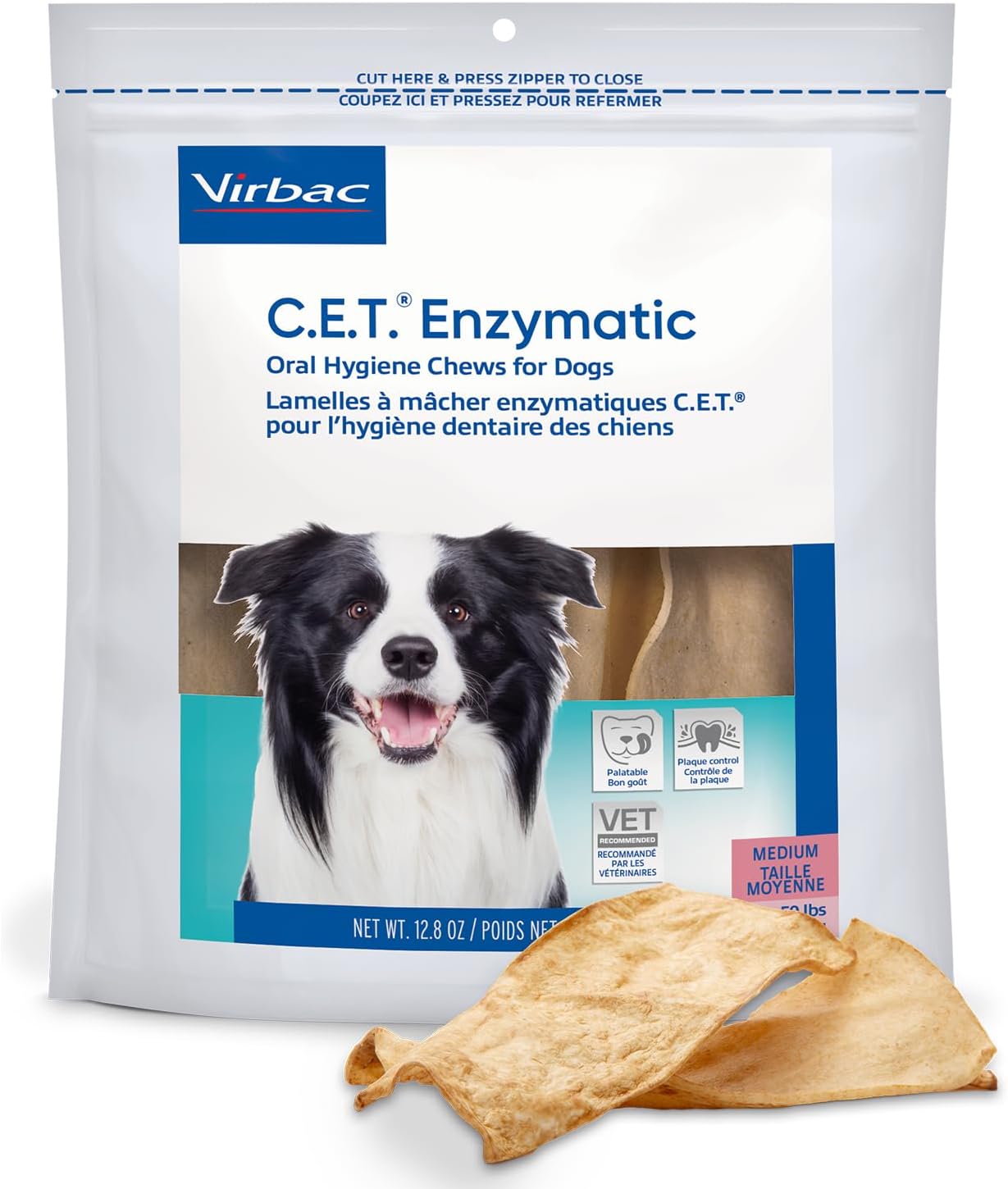
Virbac C.E.T. Enzymatic Oral Hygiene Chews
4.4 (14,675)Virbac C.E.T. chews are the ones most vets actually keep on their shelves and recommend to clients, and for small dogs especially, the enzymatic action does a lot of the heavy lifting that tiny jaws sometimes can't. My neighbor's chihuahua has noticeably less tartar buildup since switching to these, and her vet commented on the improvement at the last checkup.
Pros
- Dual enzyme system fights bacteria actively
- Vet-recommended and clinically studied
- Sized specifically for small to medium breeds
Cons
- Poultry flavor is not for every dog
- Higher price per chew than grocery store brands
Price range: $18-$35

Zymox Dog Dental Chews with VOHC Seal
4.8 (12,579)Zymox leans into their enzymatic technology heritage to deliver a chew that tackles oral bacteria without a bunch of synthetic additives, making it a solid pick for owners who read ingredient labels carefully. They're not the flashiest option on this list but they quietly do their job well, and dogs seem to genuinely enjoy the taste without being manic about it.
Pros
- Clean ingredient list with enzymatic formula
- VOHC accepted for plaque reduction
- Good option for dogs with food sensitivities
Cons
- Fewer size options than competitors
- Less widely stocked in physical stores
Price range: $16-$30
What a Daily Chew Habit Actually Costs
A dental chew is a daily expense, not a one-off purchase, and that is the part most owners underestimate. Pick the band that matches the chew you are leaning towards and see what the habit adds up to.
Quick Comparison
| Product | Best For | Price | Rating | Buy |
|---|---|---|---|---|
| Greenies Original | Overall Best | $12-$45 | 5 (1) | Check price |
| Whimzees Variety Box | Aggressive Chewers | $14-$38 | Check price | |
| Milk-Bone Brushing Chews | Budget Pick | $7-$18 | 4.7 (370) | Check price |
| Virbac C.E.T. Chews | Small Dogs | $18-$35 | Check price | |
| Zymox Dental Chews | Natural Formula | $16-$30 | 4.8 (12,579) | Check price |
Our Top Pick
Greenies Original Dental Dog Treats take the top spot because they combine proven clinical results, a VOHC seal, and a taste dogs genuinely love into one consistent daily chew. Whether you've got a tiny terrier or a big lab, there's a size that fits, and the difference in breath and tartar buildup is noticeable within a few weeks of daily use.
Check price on Amazon – Greenies Original Dental Dog Treats ($12-$45)
Of course, dental chews work best as part of a broader care routine. Keeping your dog well-hydrated helps rinse away food debris between chews; check out our guide to the Best Dog Water Bowls 2026 to make sure your pup always has fresh water within reach. And if you're putting together a full gear setup for your dog, our Best Dog Harness For Pulling and Best Dog Collars And Leashes 2025 Complete Guide are worth a read for walks that are safer and more comfortable for everyone.
Choosing the Right Chew for Your Dog's Breed
Small breeds like chihuahuas, Yorkshire terriers, and dachshunds have delicate jaw structures and smaller mouths that make oversized chews a genuine choking risk. Always size down with these dogs and choose chews specifically labeled for small breeds; the Virbac C.E.T. enzymatic chews and the teenie or small Greenies are both designed with compact jaws in mind. Medium breeds between 20 and 50 pounds have the most options since most brands center their product sizing around this range. Power chewers, think huskies, labrador retrievers, and American bulldogs, need a denser, longer-lasting chew like Whimzees that will actually take more than a minute to finish. For giant breeds over 90 pounds, always check the weight rating carefully, since a chew sized for a 70-pound dog may not provide enough structural resistance to meaningfully engage a mastiff's jaws and deliver real dental benefit.
What Dental Chews Actually Do for Your Dog's Teeth
The way dental chews work is primarily mechanical; the abrasive texture of the chew physically scrubs the tooth surface as the dog chews, removing soft plaque before it hardens into tartar. Products with the VOHC seal have passed independent tests showing at least a 10 to 15 percent reduction in plaque or tartar, which is meaningful when you consider that tartar buildup is the starting point for periodontal disease in dogs. Some chews also include enzymatic additives, like those found in Virbac C.E.T., that chemically disrupt bacterial biofilm between chewing sessions. Bad breath in dogs is almost always bacterial in origin, and a daily chew genuinely reduces the bacterial load in the mouth, which is why most owners notice fresher breath within two to three weeks of starting a consistent routine. Pairing dental chews with good nutrition and proper hydration gives you the best overall oral health outcome; our Best Dog Water Bowls guide covers the hydration side.
Using Dental Chews as Training Tools
A dental chew is one of the highest-value rewards in a training toolkit because the dog works on it over several minutes rather than consuming it in a second; this makes it ideal for teaching calm, settled behaviors like "place" (sending the dog to a mat and staying there). Giving a dental chew in the crate during alone-time training builds a powerful positive association between the crate and something the dog genuinely enjoys, which speeds up crate acceptance significantly for puppies and anxious dogs. For dogs that struggle with separation anxiety, a chew that takes 15 to 20 minutes to finish eases the transition when you leave the house by redirecting the dog's attention and energy. Just factor the calories into the daily food budget: a large Greenies chew contains roughly 54 calories, which may mean reducing kibble slightly on days you give them to avoid weight creep.
Age-Appropriate Dental Chews: Puppies to Seniors
Puppies under six months should not have standard adult dental chews; their baby teeth and developing jaws are too fragile for the abrasive texture. Look for chews specifically designed for puppies, which are noticeably softer and appropriately sized. Once the adult teeth are fully in around six to seven months, you can transition to the adult options on this list. Adult dogs aged one to seven years benefit most from daily chews, as this is when plaque and tartar accumulation compounds if unchecked, and the habit becomes much harder to reverse once calculus hardens onto the teeth. Senior dogs often have more sensitive teeth and gums, so softer chews or enzymatic options that rely more on chemistry than abrasion, like Zymox, are gentler choices. If your senior dog has any dental pain, loose teeth, or inflamed gums, consult your vet before introducing any chew, as chewing on a compromised tooth can cause pain or breakage.
The VOHC Seal: What It Actually Means
The Veterinary Oral Health Council is an independent body that grants its seal to pet oral care products that have demonstrated, through controlled clinical studies, at least a 10 to 15 percent reduction in plaque or tartar. The seal is not given based on manufacturer claims or submitted data alone: the council requires actual study evidence, usually involving dogs in a controlled trial with independent measurement of plaque or tartar levels, before awarding recognition. This is a meaningfully higher bar than marketing language like "clinically proven" or "dentist-tested," which often refers only to in-vitro lab tests or studies funded entirely by the brand without third-party validation.
Of the products on this list, Greenies and Zymox carry VOHC acceptance. That does not make Whimzees or Virbac C.E.T. ineffective; Virbac in particular is extensively used and recommended in veterinary settings for its enzymatic approach, but Greenies and Zymox have cleared the most rigorous independent bar in the consumer dental chew space. When shopping online, search specifically for "VOHC accepted" rather than relying on product listings to self-report accurately, since manufacturers sometimes make the seal claim casually without it applying to every product size or formula in their range. If your priority is the highest-confidence, independently verified option and your dog tolerates either formula well, start there.
Do Dental Chews Actually Work?
Yes, measurably, and less than a toothbrush. Both halves of that matter.
What the trials found
This has been measured properly rather than argued about. A four-month controlled study of daily oral hygiene chews found roughly 17 percent less plaque and about 46 percent less calculus against diet alone. A trial in small-breed dogs found the same direction: a single chew a day meant less gingivitis, less plaque and less tartar than the control group.
Those are real numbers on a real problem. Periodontal disease is the most common diagnosis in adult dogs, and it is painful long before an owner notices.
Where the honest limit is
Brushing wins. A study on brushing frequency found that the more often you brush the better the result, and that daily brushing outperforms anything less. The best outcome in the literature is not chews instead of brushing; it is chews on top of brushing.
So the fair way to think about a dental chew is as the thing you actually do, versus the toothbrush you keep meaning to use. A chew every day beats a brush twice a month by a wide margin, because compliance is most of the effect. If you can do both, do both.
What a chew will not do
- It will not remove tartar that is already there. Hardened calculus comes off under anaesthetic at the vet, not in the living room.
- It will not fix bad breath with a cause. Persistent halitosis in a dog is usually disease, not diet.
- It is not free. A daily chew is food and belongs inside the day's calories, which is why there is a cost calculator higher up this page.
Where to Check This Yourself
Everything on this page about which chews are accepted, and by whom, is checkable in one place rather than on our word:
- VOHC, Accepted Products for Dogs — the council's own list, with the date each product was accepted and whether it was accepted for plaque, tartar, or both. Canine Greenies has held acceptance since 2007; Purina DentaLife since 2016; Pedigree Dentastix Advanced since 2018; Virbac C.E.T. VEGGIEDENT FR3SH since 2020. If a product is not on that list, it does not carry the seal, whatever the packaging suggests.
Ingredients to Look for and Avoid in Dental Chews
The safest dental chews are made from digestible proteins, natural starches, and fiber sources that break down fully if a dog swallows a large piece quickly. When I check labels, I look for ingredients like rice starch, potato starch, natural chicken or pork derivatives, and tapioca, which are highly digestible and low-risk even for dogs with sensitive stomachs. Natural cellulose and plant fiber additives support the mechanical scrubbing action without adding unnecessary calories or allergens.
The most critical ingredient to avoid is xylitol, a natural sweetener used in some human oral care products that is severely toxic to dogs, causing a rapid and dangerous drop in blood sugar and potentially fatal liver damage at doses as low as 0.1 grams per kilogram of body weight. Always check the ingredient label of any chew or treat before giving it to your dog, particularly if it is marketed as "all-natural," "sugar-free," or borrowed from a human dental product line. Artificial dyes like Red 40, Yellow 5, and Blue 2 appear in some budget-tier dental chews and offer zero health benefit; they exist purely for human visual appeal. Also avoid chews with high sodium content, occasionally used as a palatability trick, which adds unnecessary cardiovascular strain over time, particularly in older dogs.
Raw hide is a separate category worth addressing directly: it is not a dental chew in the functional or clinical sense, and it carries well-documented risks of choking, intestinal blockage from undigested pieces, and bacterial contamination. If someone suggests rawhide as an alternative to a proper dental chew, the dental chew wins on every safety and efficacy measure, and that comparison is not close.
Frequently Asked Questions
Willemijn has kept animals for around 45 years. She did not have these particular items in her own home. What follows is her read on them, put together from research and from what she has seen at other owners' houses. We keep it separate from her hands-on notes on purpose, because the two are not the same thing.
Whimzees Variety Box. Better texture than Greenies. Drawback: The price. 4 out of 5.
Milk-Bone Brushing Chews. Less effective than Whimzees. Drawback: The effect. 2 out of 5.
Zymox VOHC Chews. Works reasonably. Drawback: The taste. 3 out of 5.
Willemijn is a friend of the founder and is not paid for this.