Our Top Pick at a Glance

48-Inch Heavy Duty Dog Crate with Wheels for Giant Breeds
4.5 (272)If you only read this far: this is the crate I point most large and giant breed owners to first, because it is built for dogs over 100 pounds rather than being a standard crate scaled up, and the drop-pin frame plus secure latches cover the two things owners complain about most. The full write-up, the pros and cons, and four other crates are further down the page.
Why a Grown Large or Giant Breed Dog Needs a Different Crate Than a Puppy
Most dog crate articles are written for the first eight weeks of a dog's life: sizing a crate with a divider panel that will grow alongside a puppy. That is genuinely useful advice for new puppy owners, but it is close to useless if your dog is already a fully grown 120-pound Great Dane or a solidly built adult Rottweiler who needs a permanent home base, not a crate they will size out of in another few months.
A crate for a grown large or giant breed dog has to solve different problems entirely. There is no more growing into it. The crate needs to be the right size on day one, and it needs to stay that size for the dog's whole life. The construction has to hold real adult weight and real adult strength, not a 12-week-old puppy's exploratory pawing. And if your dog is an escape artist or a heavy chewer, a standard wire crate rated for a 40-pound dog is not going to cut it once that same dog is pushing 90, 120, or 150 pounds of muscle against a folding latch.
If you came here after searching for "xxl dog crate," "extra large dog crate," "heavy duty dog crate," or "54 inch dog crate," this is the guide built for exactly that search. Every product below is sized for adult large and giant breeds specifically; not a puppy crate that happens to come in a large size.
Note on our other crate guide: if you are bringing home a puppy who will eventually grow into a large or giant breed, our puppy crate guide is the better starting point: it covers sizing with a divider panel so you buy one crate that grows with your puppy instead of needing to replace it. This guide is for dogs who are already full-grown and need their permanent, heavy-duty crate now.
Types of XXL and Heavy-Duty Crates for Large Dogs
Before the individual reviews, it helps to understand the three main categories of crate built for adult large and giant breeds, because the right style depends heavily on your specific dog's strength, temperament, and whether escape or chewing is a concern.
Standard-Gauge XXL Wire Crates
These are simply the largest sizes of ordinary wire crates (48 or 54 inches) using the same wire gauge as smaller sizes. They work fine for calm, well-adjusted large breeds who have no history of pushing on latches or bending bars, and they are usually the most affordable option in giant sizes. They are not the right choice for a known escape artist or a dog with serious separation anxiety, since the wire gauge and latch hardware are not reinforced beyond the standard design.
Reinforced Heavy-Duty Steel Crates
Purpose-built heavy-duty crates use thicker-gauge steel tubing, welded or reinforced joints, and multi-point locking latches specifically engineered to resist bending, prying, and repeated body-weight impacts. Many list a stated static weight-load capacity, often in the 300 to 400 pound range, which is a meaningfully different engineering standard from a crate simply labeled "XXL." These are the right call for known escape artists, heavy chewers, dogs with high anxiety who push hard against barriers, or simply any owner who wants the most durable option available regardless of their dog's current behavior.
Heavy-Duty Plastic Travel Kennels
Airline-style plastic kennels scale up to giant sizes too, and they solve a different problem than steel crates: air travel, vet visits, and a fully enclosed, den-like environment that some anxious giant breeds settle into faster than an open wire design. The trade-off is that giant-size plastic kennels are heavy, do not fold flat, and are generally more expensive than a comparable wire crate at the same size.
48-Inch Heavy Duty Dog Crate with Wheels for Giant Breeds
4.5 (272)MidWest is one of the most established names in dog crates, and their Solutions Series 54-inch model is built specifically for giant breeds over 100 pounds: Great Danes, Mastiffs, and Saint Bernards are named directly in the product description. The drop-pin construction and reinforced L-bar frame give it a noticeably sturdier feel than a standard wire crate scaled up to the same size, and the leak-proof tray and secure latches address the two most common giant-breed crate complaints: cleanup and door security.
Pros
- Purpose-built for giant breeds over 100 lbs, not just a scaled-up standard crate
- Drop-pin construction with reinforced L-bar frame adds real structural rigidity
- Double door design and leak-proof tray simplify placement and cleanup
Cons
- Heavier and more involved to assemble than a folding wire crate
- Does not fold flat for storage once assembled
Typical price range: $230–$320
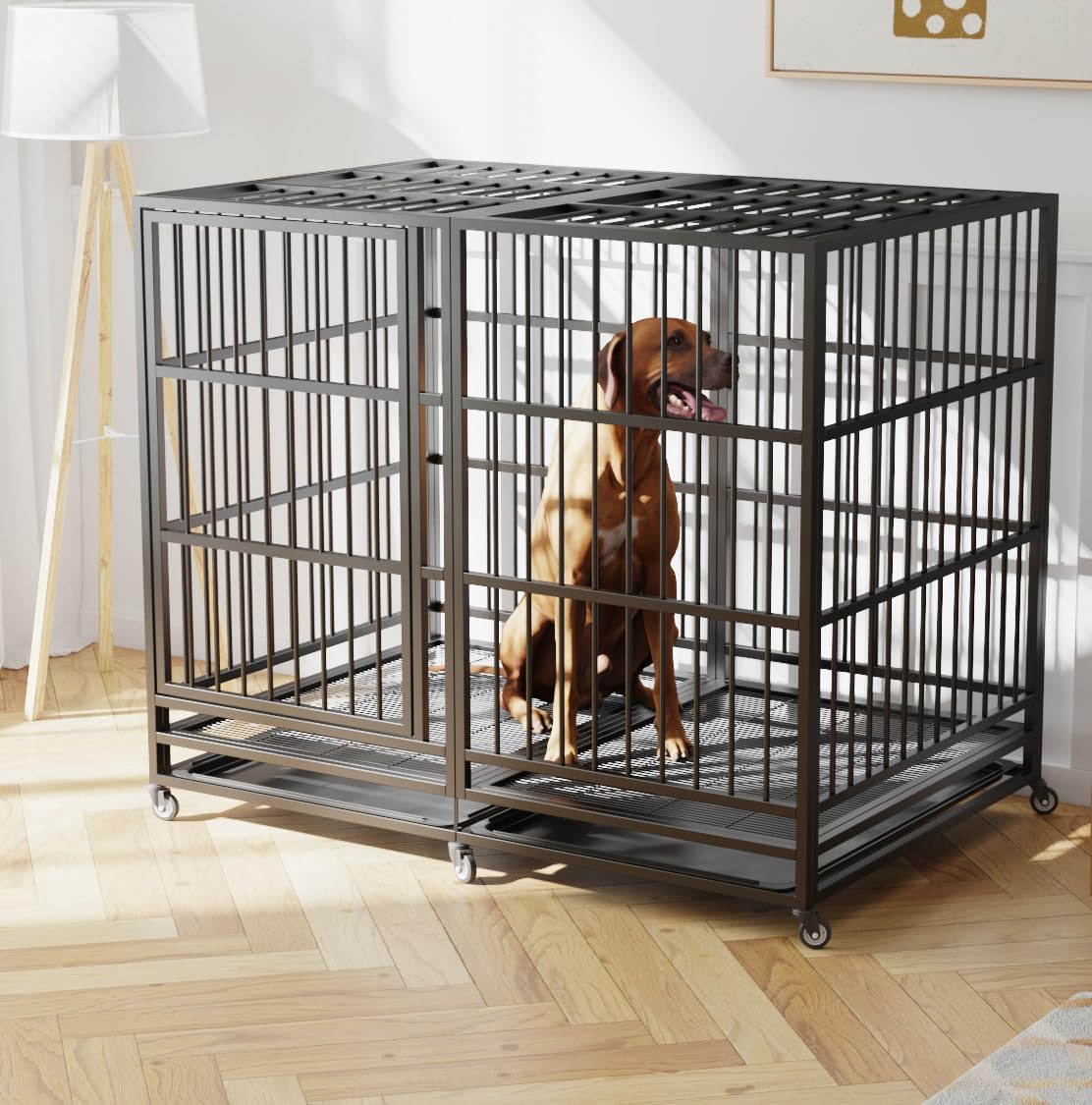
BOLDBONE 54-Inch Heavy-Duty Indestructible Escape-Proof Dog Crate
4.6 (2,651)If your dog has already proven they can bend, bite, or push their way out of a standard wire crate, the BOLDBONE is built with that exact dog in mind. It uses an upgraded 20-gauge steel frame with 0.5-inch-diameter reinforced steel tubing and lists a stated maximum static load capacity of 400 pounds (a genuinely different engineering tier from a crate just labeled "XXL"). Removable wire trays and lockable wheels round out a design clearly aimed at high-anxiety and high-strength dogs rather than average use.
Pros
- Stated 400 lb static load capacity, well beyond standard wire crates
- 0.5-inch reinforced steel tubing resists bending far better than standard gauge
- Lockable wheels make repositioning a heavy crate much easier
Cons
- Among the heaviest options here, which matters if you need to move it often
- Premium construction comes at a premium price versus standard XXL wire crates
Typical price range: $180–$260

Heavy Duty 54-Inch Dog Crate with Roof Top and Lockable Wheels
4.1 (133)This 54-inch crate is aimed squarely at high-anxiety large and giant breed dogs, with a peaked roof-top design that adds extra headroom and interior volume compared to a flat-top crate of the same footprint. Two doors, removable trays, and four lockable rotating wheels make it easier to position exactly where your dog settles best, and to move without fully disassembling it, a genuine advantage over crates that only fold flat.
Pros
- Roof-top design adds extra interior headroom for genuinely tall giant breeds
- Four lockable rotating wheels make repositioning simple without disassembly
- Two doors and removable trays simplify placement and cleanup
Cons
- Standard wire gauge rather than the reinforced tubing used on true heavy-duty models
- Wheels add bulk and height versus a stationary crate
Typical price range: $160–$230

Petmate Ultra Vari Kennel, 48-Inch, for Extra Large Dogs 90–125 lbs
4.3 (731)Petmate's Vari Kennel line has been the standard airline-compliant plastic crate for decades, and the 48-inch size is built specifically for extra large dogs in the 90 to 125 pound range. Made in the USA from heavy-duty recycled plastic, it meets most airline cargo requirements out of the box, which matters if your giant breed ever needs to fly. The enclosed shell also creates a genuinely den-like, secure feeling that some anxious giant breeds settle into faster than an open wire crate.
Pros
- Airline-compliant out of the box for dogs that need to travel by air
- Enclosed plastic shell feels more den-like and secure for anxious dogs
- Heavy-duty recycled plastic construction, made in the USA
Cons
- Does not fold flat, and is bulky to store between uses
- Tops out at 48 inches, so it is not sized for the largest giant breeds over 125 lbs
Typical price range: $150–$210

HMHTCT 48-Inch Heavy-Duty Dog Crate with Wheels and Double Door
4.3 (333)Not every large breed needs the full 54-inch giant-breed treatment; German Shepherds, Rottweilers, and Doberman Pinschers are typically well served by a well-built 48-inch crate at a more accessible price point. This model brings a locking latch system, double-door access, a removable tray, and four wheels for repositioning, without the premium price tag of the giant-breed-specific 54-inch options above.
Pros
- Noticeably lower price than the 54-inch giant-breed options above
- Locking latch and double door give large breeds real security at this price point
- Wheels make repositioning easy without needing to disassemble anything
Cons
- 48 inches is not large enough for true giant breeds over roughly 110–120 lbs
- Construction is solid but not in the same reinforced-steel tier as the BOLDBONE
Typical price range: $120–$180
Quick Comparison
| Product | Best For | Size | Price | Rating |
|---|---|---|---|---|
| MidWest Solutions 54-Inch Drop Pin | Overall best pick for giant breeds | 54 in | $230–$320 | |
| BOLDBONE 54-Inch Heavy-Duty | Escape artists and heavy chewers | 54 in | $180–$260 | |
| Heavy Duty Roof Top 54-Inch | High-anxiety dogs, extra headroom | 54 in | $160–$230 | |
| Petmate Ultra Vari Kennel 48-Inch | Air travel and den-like security | 48 in | $150–$210 | |
| HMHTCT 48-Inch Heavy-Duty | Budget pick for large (non-giant) breeds | 48 in | $120–$180 |
Giant Breed Crate Sizing Guide: 42, 48, and 54 Inch Explained
Sizing for an adult large or giant breed dog is a different exercise than sizing for a growing puppy. There is no divider panel to grow into, so the crate needs to fit correctly right now, for the dog's full adult size, and stay that way for years. The same golden rule still applies: your dog should be able to stand fully upright without ducking, turn around without touching both sides at once, and lie flat with legs extended without curling up. But because giant breeds sit right at the edge of what off-the-shelf crates are built for, getting the exact size right matters more here than for any other dog size category.
Recommended Sizes by Breed
Large breeds in the 70 to 100 pound range (Labrador Retrievers, Golden Retrievers, German Shepherds, and Doberman Pinschers) are typically well served by a 42 to 48 inch crate. Rottweilers, being both tall and broad through the chest, often do better at 48 inches even though their weight sometimes falls in the same range as a Labrador. Giant breeds over 100 pounds (Great Danes, English Mastiffs, Saint Bernards, and Irish Wolfhounds) generally need the full 54 inch size, which is the largest size widely manufactured. A Great Dane in particular can require the extra length of a 54 inch crate even at a relatively lean adult weight, simply because of how long their body is nose to tail.
Measure Your Own Dog, Don't Just Trust the Breed Average
Breed averages are a useful starting point, but individual dogs vary enough that measuring your own dog directly is worth the extra five minutes. Measure from the tip of the nose to the base of the tail while your dog is standing naturally, then add 4 inches. That is your minimum crate length. Separately, measure from the floor to the top of your dog's head while standing, and add another 2 to 4 inches for headroom. If those two numbers disagree with what breed charts suggest for your dog's breed, trust your own measurements every time.
Weight Capacity Matters as Much as Interior Dimensions
A crate can be the right physical size and still be the wrong crate if its structural weight rating does not match your dog. Standard wire crates in XXL sizes are frequently rated for dogs up to roughly 90 to 110 pounds even at 54 inches, because the size and the strength rating are two separate specifications. If your giant breed dog is on the heavier end, or is a known pusher and leaner against crate walls, look specifically for a stated static load capacity; reinforced heavy-duty models that list numbers in the 300 to 400 pound range are engineered to a genuinely different standard than a crate simply labeled "extra large."
Our Top Pick
The 48-Inch Heavy Duty Dog Crate with Wheels is our top recommendation for most large and giant breed owners because it is built by an established, trusted crate manufacturer specifically for giant breeds over 100 pounds, rather than being a standard design simply scaled up to a bigger size. If your dog is a known escape artist or heavy chewer, the BOLDBONE's 400-pound rated steel frame is worth the upgrade. And if air travel or a more enclosed, den-like feel matters more than raw structural strength, the Petmate Ultra Vari Kennel remains the most trusted plastic option in giant sizes.
How to Stop a Large Dog From Escaping a Crate
Escape-artist behavior in adult large and giant breed dogs is a different problem than a puppy testing a latch out of curiosity. A determined 100-pound dog can generate real force against a weak point in a crate's construction. A few concrete steps make a meaningful difference regardless of which crate you choose.
Match the Latch to the Dog, Not Just the Crate Size
Standard slide-bolt latches are the first thing a strong, motivated dog learns to defeat, usually by pushing the door with their nose or paw until the bolt slides free. Crates with double-locking or carabiner-style secondary latches close that gap. If your current crate only has a single slide bolt and your dog has already escaped once, adding a simple carabiner clip to the latch is a low-cost fix worth trying before replacing the whole crate.
Identify the Actual Weak Point
Watch (or set up a camera to record) exactly how your dog escapes before assuming a bigger, more expensive crate will fix it. Some dogs bend wire bars with sustained pressure. Others focus entirely on the latch. Others use their nose to lift a bottom edge that is not properly seated. Each of these has a different fix, and a heavy-duty crate with reinforced tubing solves the bar-bending problem specifically, not necessarily a latch-focused escape method.
Reduce the Motivation to Escape
A crate upgrade solves the mechanical side of escaping, but anxiety-driven escape attempts often improve faster when paired with addressing why your dog wants out in the first place. Covering three sides of the crate with a blanket, placing the crate in a quieter part of the house, and building up crate time gradually rather than jumping straight to long absences all reduce the underlying drive to escape, which makes any crate (heavy-duty or standard) more effective.
Safety Considerations for Large and Giant Breed Crating
The safety guidelines that matter for puppies still apply to adult large and giant breed dogs, but a few additional considerations become more important at full adult size and strength.
Check the Floor Surface for Joint Health
Giant breeds are more prone to joint issues like hip dysplasia and elbow dysplasia than smaller dogs, and a hard plastic crate tray without adequate padding can be genuinely uncomfortable for a large dog lying down for extended periods. A supportive orthopedic-style pad sized to the crate floor is worth the investment, especially for senior large breed dogs or those with existing joint sensitivity. If you are shopping for that pad specifically, the Big Barker Orthopedic Dog Bed is worth a look: it is made from 7-inch therapeutic foam that is designed not to flatten, is aimed at large and giant breeds, and carries a 10-year no-flatten guarantee, which matters more for a crate liner that gets used daily than for almost any other bed purchase. See our full pet beds and crates roundup for sizing and price details.
Never Use the Crate as Punishment
This rule does not change with size or age. A crate must remain a positive, safe space in your dog's mind regardless of how large or strong they are. Using the crate as a timeout for a 100-pound dog creates the same negative association it would for a puppy, and can make future crating more difficult, not less.
Remove Collars With Tags or Attachments
Collar tags and attachments can catch on crate bars just as easily for an adult dog as for a puppy, and the consequences of a caught collar are more serious with a larger, stronger dog thrashing to free themselves. Remove standard collars before crating and rely on a microchip for permanent identification instead.
Confirm the Weight Rating Before You Rely on It
Do not assume a crate is rated for your dog's weight just because the listing says "XXL" or "giant breed." Check the manufacturer's stated static load capacity directly, and if none is listed, treat that as a signal to look elsewhere rather than assuming the crate can handle a genuinely large, strong dog leaning or jumping against it repeatedly over years of use.
Frequently Asked Questions
Final Thoughts
Shopping for a crate for a full-grown large or giant breed dog comes down to three things that matter far more than they do for a puppy crate: getting the size genuinely right for your dog's adult dimensions, confirming the weight rating actually matches your dog's strength and size, and choosing construction that matches your dog's specific escape or chewing risk. A calm, well-adjusted 75-pound Labrador and a determined, 130-pound escape-artist Mastiff need very different crates even though both might get labeled "XXL" by the same retailer.
The 48-Inch Heavy Duty Dog Crate with Wheels remains our top recommendation for most large and giant breed owners because it is purpose-built by a trusted manufacturer specifically for dogs over 100 pounds. If your dog has a track record of escaping standard crates, the BOLDBONE's reinforced steel frame and 400-pound rating are worth the extra cost. If air travel or a den-like enclosed feel matters more, the Petmate Ultra Vari Kennel is the trusted plastic choice. And if your dog is a large breed rather than a giant, like a German Shepherd or Rottweiler, the HMHTCT 48-inch crate delivers solid heavy-duty features without paying for capacity you do not need.
Whatever you choose, remember that the crate is only as good as the fit. Measure your own dog rather than trusting breed averages alone, confirm the stated weight capacity actually covers your dog's size and strength, and give your dog time to settle into a new crate even at full adult size. A well-fitted, secure crate remains one of the best investments you can make in a large or giant breed dog's comfort and safety for years to come.