Why Your Cat's Litter Box Choice Matters More Than You Think
House-soiling is the most common behaviour problem cat owners report[1]. Vets diagnose and treat it under the AAFP and ISFM guidelines on diagnosing and solving house-soiling behaviour in cats[2]. Box problems are often part of it: too small, wrong style, bad location, or not cleaned often enough. A medical cause should be ruled out first.
The key factors are size, whether your cat prefers covered or open, ease of scooping, and odor containment. On size, VCA's litter box guidance is specific: a box should be about 1.5 times the length of your cat's body[3], with enough room to turn around without touching the sides. We compared the main styles below.
Before you buy: grab my checklist
The exact list I run through before recommending any pet product: ingredient red flags, real-vs-advertised specs, and the cost math brands hope you skip.
No spam. Just occasional research, straight from me.
Top 5 Cat Litter Boxes in 2026

PetSafe ScoopFree Complete Smart Self-Cleaning Litter Box
A WiFi-connected self-cleaning litter box for cat owners who want hands-free cleaning. The PetSafe ScoopFree Complete Smart connects to WiFi and gives you a dedicated app to monitor how often your cat uses the box, trigger on-demand cleanings remotely, and receive health alerts. The crystal litter trays absorb liquid and dehydrate solid waste automatically, eliminating odor for up to 30 days with one cat, according to PetSafe, before the disposable tray needs replacing. No scooping, no daily mess.
What makes the Complete Smart stand out over the standard ScoopFree is the health monitoring layer. The app logs each visit with timestamps and duration data; a change in how often a cat uses the box can be worth raising with a vet, since kidney and thyroid disease and diabetes can change urination.[1] Verified buyers consistently report that the crystal litter controls odor far better than clay alternatives, and the disposable trays mean you do not scrub the box. The main consideration is ongoing cost: replacement trays are an ongoing cost, and the crystals are not compatible with every cat's preferences; some cats dislike the texture initially. The box works best for households with one cat and owners who genuinely want to step back from the daily scooping routine.
- WiFi + app: remote monitoring and on-demand cleaning
- Crystal litter controls odor for up to 30 days
- No scooping ever: just swap the tray
- Health tracking via usage frequency data
- Available on Amazon with fast shipping
- Ongoing cost of disposable crystal trays
- Crystal litter not preferred by all cats
- Not ideal for multi-cat homes
The ScoopFree Complete Smart is the best automatic box on this list. Above it sits a genuinely different machine: the Litter-Robot 4, a rotating globe that sifts after every visit and holds a large amount of waste between empties. Whether it is the right fit depends entirely on how many cats you have and how much the daily job grates on you, so I would not push it on a single-cat household that copes fine with the ScoopFree.
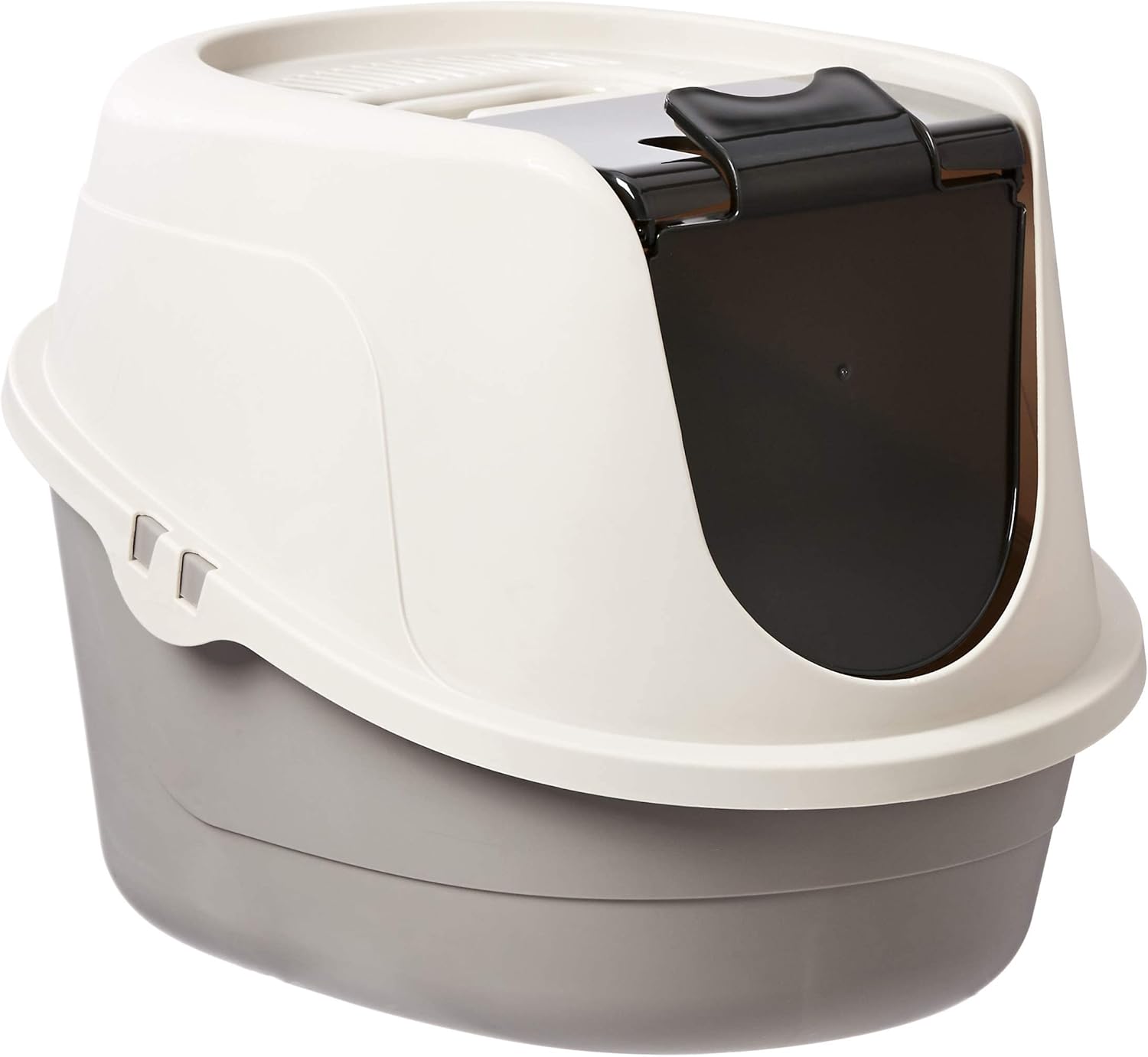
Amazon Basics No-Mess Hooded Enclosed Litter Box
The best covered litter box on this list. Large 24″ × 18″ footprint gives even big cats plenty of room to turn around, the removable hood keeps odor inside and gives cats the privacy they prefer, and the swinging door reduces litter scatter. Built-in odor control design and easy snap-on lid make cleaning fast. The low front entry makes it accessible for senior cats and kittens.
Buyer feedback on this box is remarkably consistent. Buyers highlight how straightforward assembly is (no tools, clips together in seconds), how well the hood actually contains odor versus open pans, and how forgiving the size is for medium to large breeds. The swinging door flap is a detail that matters more than it sounds: it stops litter from scattering as your cat exits, which reduces the cleanup area around the box considerably. For the price, the build quality is solid; the plastic is thick enough to resist cracking and the base is deep enough to hold a meaningful amount of litter without overflow. If your cat tolerates covered boxes, this is the single easiest recommendation I can make. If they don't, move straight to the Van Ness open pan below and save yourself the transition period.
- One of the most-purchased cat litter boxes on Amazon
- Large footprint: fits big cats comfortably
- Swinging door reduces litter scatter
- Low front entry: great for seniors and kittens
- Large 24 x 18 inch footprint
- Hood needs regular cleaning to prevent odor buildup
- Some cats dislike enclosed spaces
- No built-in odor filter

Modkat Top-Entry Litter Box
Top-entry litter boxes are the single best solution for cats that kick litter everywhere. The Modkat forces your cat to enter from the top, and the walk-off lid catches any litter stuck to their paws before they exit. Virtually eliminates litter tracking. The sleek modern design also looks great in any home.
The Modkat solves two problems simultaneously that no other box type does as cleanly. First, litter tracking: because your cat has to jump out rather than walk through a front door, any litter stuck to their paws falls back into the box through the textured lid grate before they reach your floor. Second, dog interference: most dogs cannot navigate a top-entry box, making it ideal for households with both cats and curious dogs. The interior dimensions are generous enough for average-sized cats, though very large breeds (Maine Coon, Norwegian Forest Cat) may feel cramped. The reusable liner included with the Modkat is a practical addition; it protects the plastic base and swaps out easily during full cleans. Buyer reviews consistently praise how much it reduced litter scatter around their homes, with many calling it the best litter box upgrade they made. The one firm limitation: senior cats or kittens who cannot jump confidently should not use this style.
- Eliminates litter tracking
- Prevents dogs from accessing
- Sleek modern design
- Easy to clean interior
- Reusable liner included
- Not suitable for senior cats
- Kittens may struggle to enter

PetSafe ScoopFree Self-Cleaning Litter Box
The classic PetSafe ScoopFree without the app features: a simpler auto-cleaning option. This model uses crystal litter trays that absorb liquid and dehydrate solid waste: automatically raking waste into a covered compartment 20 minutes after use. Disposable trays mean no scooping and minimal smell for weeks.
The core mechanism is reliable: a plastic rake moves across the crystal tray on a timer after each use, pushing solid waste into a covered compartment at the end of the tray. Crystal litter absorbs liquid far faster than clay, which is why odor control can genuinely last weeks between tray changes. The main practical difference from the Complete Smart version is the absence of WiFi and app connectivity: there's no usage tracking, no remote monitoring, no health alerts. For cat owners who don't want to manage another app, this is actually a feature rather than a limitation. It still delivers the core benefit of hands-free cleaning. The 20-minute wait cycle before raking is a safety feature worth knowing: if your cat re-enters the box during that window, the timer resets, which occasionally means waste sits longer than expected in very active cats.
- Automatic self-cleaning
- Disposable trays: very low effort
- Crystal litter controls odor well
- No app subscription required
- Ongoing tray replacement costs
- Crystal litter not preferred by all cats
- Not suitable for multiple cats

Van Ness Extra Giant Litter Pan
Sometimes simple is best. The Van Ness Extra Giant pan is enormous: giving even the largest cats all the space they need. Open pans are preferred by many cats, especially those who feel anxious in enclosed spaces. The polished finish prevents litter and waste from sticking to the bottom.
Open pans remain the first choice for a large proportion of cats, particularly those who have had negative experiences with covered boxes, those who feel anxious when enclosed, and older cats who simply want to step in and out with minimal effort. The polished interior surface of the Van Ness is a genuine practical advantage: clay litter tends to stick and build up on rough plastic surfaces, but the smooth interior of this pan wipes clean in seconds. The extra-giant size means even Maine Coons and large domestic shorthairs have room to move, dig, and turn without feeling restricted. There's no odor containment, which is the tradeoff, but used with a high-quality clumping litter and scooped daily, odor is very manageable. As a secondary box in a multi-cat household or a simple solution for a single indoor cat, this is a dependable choice.
- Extra giant size
- Most cats prefer open boxes
- Easiest to clean of all options
- Simple design, nothing to break
- No odor containment
- Litter tracking with active cats
- Less aesthetically pleasing
Quick Comparison Table
| Product | Type | Self-Cleaning | Best For |
|---|---|---|---|
| PetSafe ScoopFree Complete Smart | Automatic | Single-cat homes, app lovers | |
| Amazon Basics Hooded | Covered | Large cats, covered box | |
| Modkat Top-Entry | Top-entry | Litter trackers | |
| PetSafe ScoopFree | Automatic | Single cat homes | |
| Van Ness Giant Pan | Open pan | Simple open pan |
What to Measure Before You Buy
Choosing the right litter box starts before you even look at products. Getting these three measurements right prevents the most common mistake: buying a box your cat won't use.
- Your cat's length: VCA puts the box at about 1.5 times the length of your cat's body[3], measured nose to base of tail. A 45cm cat needs a box at least 67cm long. Always check interior dimensions, not box dimensions.
- Available floor space: Measure the spot where the box will live. Covered and top-entry boxes need clearance above for the lid. Automatic boxes often need a power outlet within reach.
- Number of cats: Cornell's guidance is one box per cat plus one extra, so two cats means three boxes.[1]
Also consider your cat's age and mobility. Small kittens, senior cats and cats with reduced mobility need sides low enough to get in and out comfortably[3]; the front step height matters.
Covered vs Open: Which Does Your Cat Actually Prefer?
Whether a cat accepts a covered box is individual to your cat, not a universal rule. Here is what the sources below say:
- Covered boxes work best for cats who are naturally private, who have always used a covered box, and for owners whose main concern is odor containment and litter scatter.
- Open boxes work best for cats with any history of box avoidance, anxious cats, multi-cat homes where one cat might ambush another at the box entrance, and senior cats who need easy low-step access.
- Top-entry boxes are a special category; many cats love them, particularly active younger cats, but they're completely unsuitable for elderly or less mobile cats.
Cornell describes an uncovered box as one that lets odors escape and gives a cat a 360-degree view of its surroundings.[1] The ASPCA says most cats do not like box liners or lids[4], and that most cats prefer large boxes they can enter easily.[4] Evidence: limited
If your cat has been avoiding their litter box, removing the cover is a simple first test.[4]
Top-Entry vs Front-Entry: Which One Actually Ends the Litter Trail?
Covered versus open is about whether your cat feels safe. Top-entry versus front-entry is a different question entirely, and it is the one that decides whether you sweep the hallway every morning. Both styles work; they fail in opposite directions, so the honest answer depends on the cat you have rather than on which looks tidier.
A top-entry box, like the Modkat, is the better choice when litter tracking is your main complaint. Your cat jumps out through a textured lid instead of walking through a doorway, so litter caught in their paws drops back into the box before they reach your floor. The same design can help keep dogs out. The trade-off is mobility: a cat has to jump in and out with ease. Small kittens, senior cats and cats with reduced mobility need sides low enough to get in and out comfortably, so a top-entry box may not suit them.[3]
A front-entry box, like the Amazon Basics Hooded, is the better choice when access matters more than scatter. The low step suits kittens, senior cats and large cats.[3] You will track more litter, and the fix is a mat rather than a different box.
If you are choosing for a cat you already know, the deciding question is simple: has this cat jumped onto a kitchen counter in the last month? If yes, a top-entry box is more likely to suit them. If not, do not make the litter box the thing they have to learn to jump into. If you are buying for a kitten now, buy front-entry and revisit the question at a year old.
Best Litter Box Setup for Multiple Cats
Multi-cat households need a different approach to single-cat homes.
Cornell's guidance is to provide as many boxes as there are cats in the house, plus one. This decreases competition and gives each cat a box of its own.[1] Evidence: limited
For two cats, start with three boxes: two covered (like the Amazon Basics Hooded) placed in different rooms, and one open large pan (Van Ness Extra Giant) as a neutral third option. Place boxes so that no single cat can sit in one location and visually guard access to all three.
Self-cleaning boxes like the PetSafe ScoopFree are rated for single-cat use. In a two-cat household they'll clean frequently enough but the disposable trays will need replacing more often. For three or more cats, a self-cleaning automatic box is not practical as a primary solution; you need multiple manual boxes cleaned at least twice daily.
Looking for more multi-cat guidance? Our cat care tips guide covers feeding, territory, and enrichment strategies for multi-cat homes.
Best Litter Boxes for Kittens
Kittens need sides low enough to get in and out easily.[3] The Amazon Basics Hooded box has a low front entry. The Van Ness open pan has no hood or door to step through.
Skip top-entry boxes for a kitten. VCA's kitten guidance is that a kitten needs sides low enough to get into and out of easily[3]. Check the manufacturer's minimum age or weight before putting a kitten in front of an automatic box.
Best Litter Boxes for Large Cat Breeds
Maine Coons, Norwegian Forest Cats, Ragdolls, and large domestic shorthairs can find standard-size litter boxes cramped. The Van Ness Extra Giant pan is one of the largest open pans on this list. The Amazon Basics Hooded has a 61cm interior length.
Top-entry boxes like the Modkat have limited interior space for very large cats; check the interior dimensions before buying for a large or heavy cat.
Litter Type Compatibility
Not every box works with every litter type; this is worth checking before you buy:
- Clumping clay litter: Compatible with all box types. The most widely used type and works in every box on this list.
- Crystal/silica litter: Required for the PetSafe ScoopFree automatic boxes. Not suitable for use in standard manual boxes (it doesn't clump and won't scoop like clay). Most cats accept it, but a transition period is normal.
- Pine/wood pellet litter: Works in open pans and covered boxes. Not compatible with automatic raking mechanisms.
- Paper litter: Best used in open pans. Paper doesn't clump well, which makes it incompatible with automatic self-cleaning boxes.
- Tofu/plant-based litter: Compatible with manual boxes. Some varieties clump well enough for automatic boxes; check the specific product's compatibility.
If you're choosing litter at the same time as a box, see our guide to the best cat litter options in 2026: the right litter and right box together make a significant difference to odor control and your cat's willingness to use the setup.
Our Final Verdict
For most cat owners, the Amazon Basics Hooded Litter Box is our top covered pick: great odor control and an extra large size. If litter tracking is your biggest problem, upgrade to the Modkat Top-Entry and the problem disappears overnight.
If you want to never scoop again, the PetSafe ScoopFree Complete Smart pays for itself in time saved within a year, and the WiFi monitoring adds a genuinely useful health-tracking layer.
How to Get Your Cat to Use a New Litter Box
- Place it in the right location: quiet, accessible, away from food and water. Never in a loud or high-traffic area.
- Keep the old box during transition: put the new box next to the old one. Let your cat choose when to switch.
- Transfer some used litter: adding familiar-smelling litter to the new box helps cats identify it as theirs.
- Never force your cat inside: let them explore on their own terms. Cats are naturally curious.
- Scoop daily regardless of box type: even the best box fails if it's not kept clean. How often the whole box needs emptying depends on the litter, and we work that through in how often to change cat litter.
The two-week version, in order
- Days 1–3: both boxes, side by side. New box next to the old one, same room, both filled with the litter your cat already uses. Change one thing at a time; a new box and a new litter at once tells you nothing when it fails.
- Day 3: seed it. A scoop of used litter from the old box into the new one. You are not being unhygienic, you are telling the cat whose box this is.
- Days 4–10: let the numbers tell you. If the new box is getting used, start scooping the old one less often, never the new one. Cats vote with their paws for the cleaner box.
- Day 10–14: remove the old box. Only once the new one has been used for several days running. If you take the old box away and accidents start, you moved too early: put it back and add a week.
Where people go wrong
- Changing the litter at the same time. The single most common mistake, and it makes the result unreadable.
- Moving the location. A new box in a new place is two changes. Keep the spot, change the box.
- Adding a lid. The ASPCA notes plainly that most cats do not like liners or lids. If you are switching to a covered box, expect to take the lid off for the first fortnight.
- Going straight to a top-entry or automatic box. Both ask the cat to learn something. Introduce them with the old box still available for at least two weeks, not one.
The thing to rule out first
If your cat was using a box happily and stopped, do not start with a new box at all. Cornell lists kidney and thyroid disease and diabetes as possible causes of box avoidance, because they often lead a cat to drink more and urinate more often.[1] Evidence: limited A cat that associates the box with pain may avoid the box rather than the pain.[1] Buying furniture first can waste the weeks the cat does not have.
Once a vet has ruled out medical causes, stress is the next thing to look at. A cat that feels ambushed at the box, or that has had its territory changed by a move, a new pet or a noisy household, can avoid the box even when the box itself is fine. Plug-in pheromone diffusers are one option. A 2011 meta-analysis of ten trials found pheromone therapy may help with urine spraying beyond a placebo. That is a different problem from box avoidance, so the evidence is indirect.[5] Evidence: strong Cat Mum Journal has a comparison of plug-in pheromone diffusers.
A happy, healthy cat is about more than just the right litter box. If you're optimising your cat's setup, our best cat food for indoor cats guide covers nutrition choices that make a real difference to digestion and litter box habits.
Where the Veterinary Guidance Comes From
Product claims on this page come from verified buyer reviews, spec sheets and ingredient labels. The behavioural guidance, how many boxes, what size, and why cats reject a hood, comes from published veterinary sources rather than from me, and you should be able to check it yourself:
- Cornell Feline Health Center, Feline Behavior Problems: House Soiling — box count, placement, size by cat, and why covered boxes trap odour.
- ASPCA, Litter Box Problems — box size preference, liners and lids, and what to do first when a cat starts going elsewhere.
Frequently Asked Questions
Also worth reading: best cat litter, the right litter matters as much as the right box for odor control. And if you travel or work long hours, our best automatic cat feeder guide covers the top options for keeping your cat fed on schedule.
Sick of scooping every single day?
Every box on this page still needs a human with a scoop. The self-cleaning ones are a different purchase, and they get their own comparison.
Best Automatic & Self-Cleaning Litter Boxes →Willemijn has kept animals for around 45 years. She did not have these particular items in her own home. What follows is her read on them, put together from research and from what she has seen at other owners' houses. We keep it separate from her hands-on notes on purpose, because the two are not the same thing.
Amazon Basics No-Mess Hooded. It held the smell in well, but it was on the small side. Drawback: Too small. 3 out of 5.
Modkat Top-Entry. Beer did not understand it and would not go in. Drawback: Beer would not use it. 1 out of 5.
Van Ness Extra Giant. Beer uses it happily, it is easy to clean and big enough. Drawback: No hood. 5 out of 5.
Willemijn is a friend of the founder and is not paid for this.
References
- Cornell Feline Health Center. Feline Behavior Problems: House Soiling. Cornell University College of Veterinary Medicine. Source
- Carney HC, Sadek TP, Curtis TM, et al. AAFP and ISFM Guidelines for diagnosing and solving house-soiling behavior in cats. J Feline Med Surg. 2014. PubMed
- VCA Animal Hospitals. Housetraining for Kittens and Cats. Source
- ASPCA. Litter Box Problems. Source
- Mills DS, Redgate SE, Landsberg GM. A meta-analysis of studies of treatments for feline urine spraying. PLoS One. 2011. PubMed